| COM- Content |
Company Operational Manual COM 1.1 Business Management |
Doc No.: COM 1.1
Revision: 0 Date: 15 Apr 2023 Issued by: DPA Approved by: MD |
Business Management
1.1 Purpose
Use this document for management of Company’s business relationship with its clients.
1.2 Scope
This document defines procedures for:
- Management of change
- Business administration for existing and new clients
1.3 Hazard
Based on industry data and internal risk assessment, we have identified these main hazards for a client:
- Non-IACS class
- Non-International Group Club P & I insurance
- Vessel age
- Detention history
- Owner financial status
- Ship’s flag blacklisted
- Non-ITF agreement
1.4 Mitigation
To mitigate the risk from these hazards, use the guidelines and step procedures in this document.
1.5 Introduction
This procedure is applicable to the management of the company’s business relationship with its clients, through implementation of the terms and conditions of specific management agreements. The procedure details the requirement for managing the full scope of a contract, including:
- Risk assessment
- Management agreements
- New business
- Budgeting and contract negotiations
- Vessel inspections pre and post delivery
- Vessel delivery into management
- Critical business administration procedures
- Performance evaluation through:
- Contract review
- Client service reports
- Contract termination and vessel re-delivery
| Term | Definition |
|---|---|
| Client | A company that has negotiated or is negotiating a ship management agreement. |
| Company | The contracting company and the sub-contracted management office. |
| Agreement | A contractual document defining the business relationship between the client and the company, including:
|
| Contract | Term for the full scope and realization of services provided in accordance with an agreement. |
1.7 New Business
1.7.1 Evaluation Criteria for New Business
Obtain a firm commitment from the owners for new build including:
- Green Passport
- Complete inventory in the new build agreement
Check the new business for the following criteria before entry to management:
| Evaluation Criteria |
|---|
|
• Maintained Class with IACS Class Society since new build • P&I insurance must be with International Group Club. • Maximum Age: o Cargo ships and other “dry” vessels up to 17 years old o “Wet” (including LPG) vessels up to 20 years o LNG vessels up to 25 years. • Port State History: maximum 1 detention in the previous 2 years, maximum 10 defects in same period. • Vessel must not appear on USCG blacklist (previous owner or vessel). • Vessel or owner are not on US or other governmental sanctions blacklist. • A copy of the client’s latest audited accounts and a report from a credit risk rating company (e.g. Infospectrum or similar) has been received. The accounts / credit risk report should demonstrate that the client will be able to fund the vessel’s operating costs. • The ship’s Flag is not to be on the Paris MOU blacklist. • There must be no Conditions of Class, or Conditions of Authority, in place affecting trading. • Vessel must be crewed through the company crew management system. • Aside from new builds, the vessel must have been inspected by Ship management company staff in the last 3 months. • The crewing agreement must be in line with ITF agreements. • Management Agreement to be under English law. |
1.7.2 New Business Risk Assessment
Risk Assessment Considerations for Full Management
Record initial and final risk levels in A16. Consider for preparing A16:
- Vessel condition report - Note: The Company ships report must detail level and condition of spares, lube oil costs, latent defects, possible future defects, repairs, survey, new legislation, etc.
- 3rd Party reports - Note: For example, Sea web, Equasis, etc.
- Budget control, including:
- Pre-delivery
- Capex
- Exceptional
- Client background including funding
- Available office resources
- Familiarization of office staff
- Crew agreement arrangement
- Crew supply capabilities
- Experience matrix
- If applicable:
- Observers attending prior takeover
- If applicable:
- Insurance concerns
- Technical issues
- Any other items
We recommend the team assigned for takeover to brainstorm the risks and benefits to the company. If risk to the company or the client during the period of the contract, utilize part of any decision-making process.
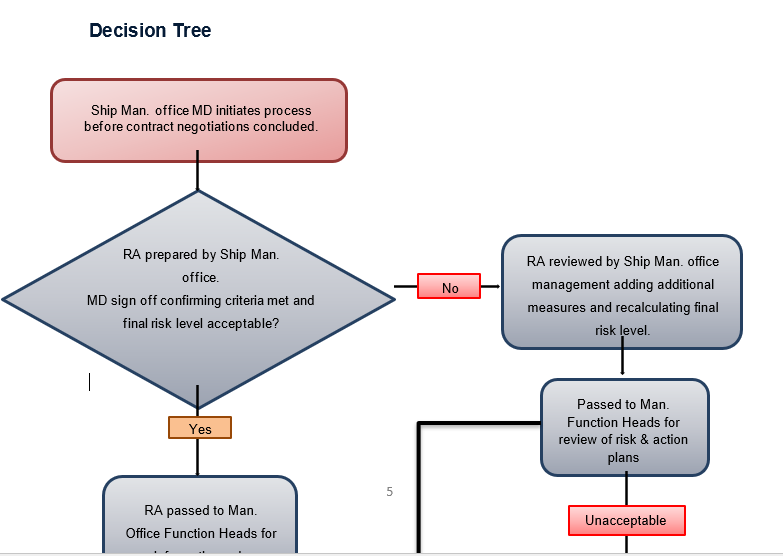
Circulation
Complete and circulate A16
| Level | Meets Minimum Criteria | Risk Level = 3 or below | Risk Assessment Approval |
|---|---|---|---|
| 1 | Yes | Yes | Final Approval by MD. Forward copy of RA for records. |
| 2 | Yes | No | Review RA and if possible, strengthen controls to reduce Residual Risk to 3 or below. If YES, then same as Level 1. If NO, RA needs HSSEQ Department sign-off. Risk level greater than 3 requires HSSEQ Department sign off. |
| 3 | No | Yes | Completed RA to HSSEQ Department. Not meeting minimum criteria requires HSSEQ Department sign-off. |
| 4 | No | No | Consider if risk excessive. If YES, HSSEQ Department in consultation with MD to REJECT vessel. Copy of RA for information. |
| 5 | No | No | If Risk considered by HSSEQ department acceptable, forward completed RA to Managing Director. Managing Director SIGN-OFF REQUIRED. |
New Business Risk Assessment Procedure
The HSSEQ Manager must do this procedure and appoint an individual to collate information.
This procedure is applicable for a vessel entering full management. If deviation occurs, notify the Managing Director.
Steps to Follow
- Follow Decision Tree
- Complete A16
- If credit risk report indicates funding delay:
- Check with Finance Manager & Managing Director
- Circulate A16
Warning! Do not allow vessel entry to management without pre-entry risk assessment.
New Business Risk - Stop-Work Authority
After the project risk assessment has been approved for management entry, the hazard controls stated within A16 shall be closely monitored throughout the delivery project. In the event that stated controls change, or cannot be fulfilled, the A16 shall be revised and submitted for re-approval in line with this procedure.
New Business Procedures
1.7.3 Inspections
Do We Inspect New Business Vessel?
Inspect vessels, except new builds, prior to management takeover. Check for requirements including:
- Crew
- Operation
- Maintenance
- Any other risk
If exceptional circumstances, the Managing Director may give a waiver for inspection. The request for a waiver must include documentation, including:
- Observers report
- Owners or Buyers sale and purchase report
- Previous third-party inspection report
- Class status report
Pre-Takeover Inspection Status
| Completed | Takeover Inspection Requirement |
|---|---|
| ▶ | Complete post-takeover inspection within 3 months. |
| MD waiver in place & no inspection | Complete full technical inspection at takeover port. |
New Business Vessel Inspection Procedure
The HSSEQ Manager must do this procedure before taking a vessel into management. If deviation, notify Managing Director.
- Appoint Superintendent
- If client approves, consider using:
- Vibration analysis
- Thermography
- Lube oil analysis
- Superintendent to check:
- Condition of vessel
- History
- If applicable, new regulations
- Send copy of the report to HSSEQ Department & Technical Department.
- Maintain report in ship's file in the office.
- If Managing Director waiver, complete A13 after delivery.
1.7.4 New Business Potential & Negotiations
Business Potential
The HSSEQ Manager must coordinate the company’s services with MD under his/her strategic direction. The HSSEQ Manager is responsible for:
- Response to client enquiries
Note: The requirement for confidentiality is applicable both externally and internally.
If firm potential for a contract, the Managing Director shall allocate the vessel to HSSEQ Manager / Technical Manager considering:
- Client’s preference
- Management effectiveness
- Requirement for expertise
- Company strategic requirement
Note: MD must be familiar with the details of the potential contract.
Who Negotiates?
The MD, with the support of the HSSEQ Manager, negotiates with the clients. Negotiations should consider:
- Terms and conditions in the Company’s standard agreement
- Specific requirements
General
After submission of the budget, approval of the potential client, and completion of the vessel inspection, we may submit a further budget proposal with a disclaimer:
“Direct revision following a vessel inspection by Ship Management company personnel and subject to a 3-month revision after delivery as per full machinery assessment.”
Before Completion of Negotiation Procedure
The HSSEQ Manager with the support of the Technical Manager should do this procedure.
- Review contract.
- Confirm A16:
- Closeout
- Approval by Managing Director
- If applicable, identify risks and management controls specific to the contract.
- If applicable, approval of changes to the Company’s standard agreement.
- Confirm Budget approval, including:
- Ongoing maintenance standard
- Manning level
- If upgrading maintenance, confirm approval for:
- Capex
- Exceptional cost
- Define:
- Management performance criteria
- If applicable, specific reporting requirements
- Confirm availability of company resources.
After Completion of Negotiation Procedure
The HSSEQ Manager shall do this procedure. If deviation, notify Managing Director.
- Agree to delivery schedule.
- Maintain contact with the client during the period before delivery.
- If changes in requirement:
- Document
- Act as necessary
1.7.5 Management Agreements
What is a Management Agreement?
The agreement governs the terms and conditions of the company’s business relationship with a client.
What Type of Agreement to Use?
| Type | Description |
|---|---|
| Ship Management Agreement | Where the Company is employed by the client to act as the manager of a vessel, providing comprehensive technical and crewing services. |
| Crew Management Agreement | Where the Company is employed by the client to act as the crew manager of a vessel, providing crewing services only. |
| Contract Crewing Agreement | Where the Company is employed by the client to supply a full or part crew to a vessel and where the client retains management responsibility for the crew. |
| Other Service Agreements | The relationship of entities supplying other services, e.g., post-fixture management, consulting, new building supervision, are controlled by customized agreements. |
Who Finalises the Agreement?
The ship management company contracting party is the entity performing the management service. Exceptions are allowed for statutory flag requirements or specific client needs. If there is an exception, the Managing Director must confirm.
Agreement Finalisation Procedure
The MD must do this procedure:
- Confirm signature on two sets of agreement by:
- Company authorized signatory
- Client authorized signatory
- Confirm signature of both authorized signatories on each page.
- Give one set to the client. Note: Finance Manager maintains all agreements.
- Update record of agreements in force.
1.7.6 New Business - Crewing
New Business Crewing Procedure
The Crew Manager must do this procedure before vessel entry to management. This procedure is for contracts originating from HSSEQ Manager.
- Confirm MD initiates RA.
- Check RA in line with A16.
- Sign off RA.
- If credit risk report indicates funding delays:
- Get Finance Manager to sign off RA.
- Maintain risk assessment register.
1.8 Budgets
1.8.1 What Type of Budget to Use?
Two types of vessel budget are used:
- Estimated
- Approved
Use operating cost budget:
- To control operating cost expenditure
- As a basis for:
- Vessel accounting
- Financial reporting
- Performance measurement
1.8.2 How to Prepare Budget?
Use company budgeting system with reference to budget assumptions, including:
- Information on crew cost options
- Variables (Include CAPEX and exceptional costs)
- Performance assured services (if applicable - e.g – Catering (Garret), Air time, etc)
Note: Certain budget elements are compulsory or fixed.
Present operating and crewing cost budgets in a standard format. Show annual and quarterly expenditure by major expense categories. Decide the management fee in consultation with the Managing Director.
1.8.3 Vessel Budget Estimation Procedure
The Technical Manager must do this procedure.
- Prepare budget in consultation with MD, including:
- Senior functional managers
- Base estimation on information by client
- If applicable, consider similar vessel in management
- Send quotation to client
- Include disclaimer
Note: Subject to revision following a vessel inspection by Ship management company personnel and subject to a 3-month revision after delivery as per full machinery assessment
If no inspection before delivery in management:
- Inform client stating:
- Budget subject to revision after three months operating experience
1.8.4 What is Approved Vessel Budget?
Consider a budget as approved operating cost budget, after either:
- Client approval
- Submission on acceptance under the terms of the management agreement
1.9 Delivery into Management
1.9.1 What to Do for Vessel Delivery in Management?
Plan a delivery schedule in agreement with client. Consider the terms of agreement. If applicable, consider specific client requirements.
If delivery at the time of purchase, special arrangements may apply.
Use A16.
1.9.2 Records for New Business Project?
Maintain the following records in a file:
- Sale and Purchase MOA
- Risk Assessment, including Managing Director sign-off
- A16
- Pre-delivery costs budget
- OPEX and budget proposals
- If applicable, charter party
- Survey status
- PSC review (e.g – Equasis, etc)
- Flag correspondence including ISM code declaration of:
- Company
- DPA
- CSO
- Class Correspondence
- Observers’ details, including joining letter
- Observers’ reports
- Pre-Purchase or delivery inspection report
- If applicable, Managing Director waiver
- Supplier agreement forms (e.g – Inmarsat activation, GMDSS Shore Based Maintenance, Chart Supplier, etc)
- Delivery safety inspection (as required)
- Onboard training and familiarization records
1.9.3 Why Have Observers?
Observer’s attendance is to:
- Support the company in planning actions
- Integrate crew and vessel with the Company’s SMS procedures.
Through onboard testing, familiarization, and review of records, the observers must identify risks to:
- Safety
- Environmental compliance
- Mechanical reliability
After agreement with client, place as observers in enough time before delivery schedule:
- Senior officer
- If applicable, superintendent
Only experienced company personnel must be observers. Brief observers on:
- Requirements
- Delivery process
- Reporting template
1.9.4 Instruction to Observers?
Provide observer with a copy of A26 Discuss and review A26 during pre-joining meeting.
Note: A26 is a standard format. It may be amended for vessel specific requirements.
The instructions include checks and tasks to do immediately after vessel entry into management.
See – A26 - Observers Instructions
1.9.5 Before Vessel Delivery Procedures
Technical Superintendent Before Delivery Procedure
Checklist
The Technical Superintendent must do this procedure before delivery date.
The Technical Superintendent may liaise with owner representative or observers to gather information.
If deviation, notify Technical Manager.
- Prepare running cost:
- Daily
- Annual
- Get approval for:
- Budget
- Accounts
- Appoint agent at delivery port
- Arrange:
- Technician for:
- SSAS reprogramming
- Radio station programming
- Radio survey
- EPIRB
- AIS
- VDR
- Note: Technician must be Class Approved
- If applicable, class attendance for change of either:
- Name
- Flag
- If applicable, Under Water Survey (UWS)
- Note: Memorandum of Agreement (MOA) must mention requirement for UWS
- Technician for:
- Confirm ROB quantity of:
- Fuel
- Lube oil
- Confirm specification of ROB
- Check bunker requirement
- If required, arrange for bunkers
- Get list of critical spares
- Coordinate delivery of:
- Spares
- Stores
- Confirm testing record of:
- Foam analysis
- CO2 hydraulic
- BA compressor
- Confirm certificates of:
- Breathing apparatus
- EEBD servicing
- Anchor
- Cable chain
- De-ratting
- IOPP, including:
- 15ppm oil filtering equipment
- If applicable, ODME
- Incinerator
- Ship lifting appliances
- Cargo handling gear
- Arrange contracts for:
- Analysis:
- Fuel
- Lube oil
- Hydraulic oil
- If applicable, hired equipment
- Analysis:
- Arrange class approval for Chief Engineer to perform CSM items
- Procure:
- Machinery service letters for:
- Main
- Auxiliary
- OWS:
- If applicable, 3-way interlock valve
- Flange seals
- Machinery service letters for:
- Collect from previous owner or managers for main machinery:
- Total running hours
- Running hours since last overhauling
- Major components with photographic evidences
- If applicable:
- Request for EU MRV monitoring plan
- IMO -DCS
- SEEMP Part I
- SEEMP Part II
- SEEMP Part III
- If applicable, obtain warranty engineer agreement
- Use A16
HSSEQ Before Vessel Delivery Procedure
The Marine & HSEQ Superintendent must do this procedure before vessel entry into management.
If deviation, notify HSSEQ Manager.
- Obtain SMS documentation from HSSEQ department
- Note: Use SMS order form
- Arrange supply of SMS documentation
- Confirm with Master receipt of SMS documentation
- Get approval for:
- SOPEP
- If applicable:
- SMPEP
- Panama SOPEP
- If tankers:
- STS Plan
- VOC Plan
- BWMP
- Do Ship security assessment
- Get Ship security plan approval
- Apply:
- CSR to flag state
- Safe Manning Certificate
- Radio License
- If Tanker, CLC certificate
- Bunker CLC
- If applicable:
- Eastern Canada response corporation (ECRC)
- Compliance with EU advanced cargo regime
- Request DMLC part 1 from flag
- Make emergency towing booklet ship specific
- Check LSA & FFA training manual
- Register Satcom with AAIC
- Check EPIRB registration
- Place on board:
- Copy of declaration of company
- Copy of designated person for registration to flag state
- Flag state regulation
- If applicable, NAV 27 publications
- Registry flag
- Radio license
- P&I booklet, including:
- Correspondent